Drinker’s Hall of Fame
Once Upon a Time in HollywoodThe Drinker’s Hall of Fame is a San Gabriel bar whose walls turn Hollywood’s drinking history into a place of gathering and conversation. Rick Dalton and Cliff Booth come there with Jim Stacy after Stacy’s first day filming the pilot for Lancer. The room’s celebrity memorabilia makes the bar a memorial to performers and their public images, while its regulars, music, and conversation give it a practical role as a meeting place for actors. Rick’s doubts about his career emerge there not as an office postmortem but in the company of colleagues, over drinks and among reminders of Hollywood lives shaped by alcohol.
Setting and Memorabilia
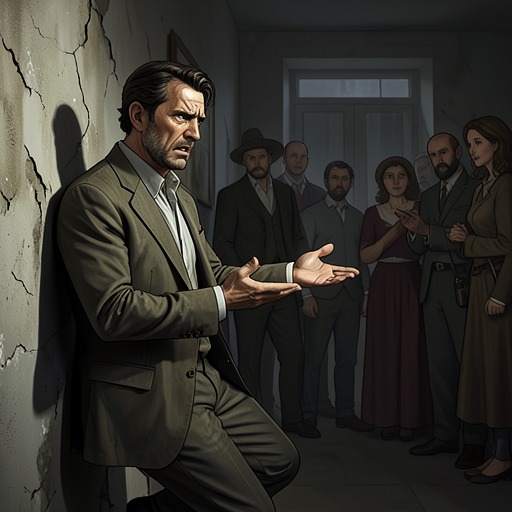
The three arrive at eight in the evening, following Stacy’s motorcycle in Rick’s Cadillac to a barn-red building with a gravel driveway. The bar is not packed, but its regulars give the dark room a settled, familiar character. It serves San Gabriel locals, actors, and musicians, and presents itself as a cozy, nostalgia-based watering hole. Its identity is announced in the décor: memorabilia of famous Hollywood figures associated with lives damaged by booze covers the walls.
Four large framed posters occupy the highest place of honor. W. C. Fields appears in a gray top hat, studying a poker hand; Humphrey Bogart wears a trench coat and snap-brim fedora; John Barrymore is shown in his handsome silent-film years; and Buster Keaton wears the flat pork pie hat and black vest associated with his screen heyday. These four are distinguished from the other images not only by their position but by their frames. The bar’s arrangement gives its chosen patron saints a ceremonial prominence.
Other photographs and publicity images, many yellowed or browned with age, run above the liquor shelves. Some are signed: Lee Marvin appears in his white shirt and black vest from The Man Who Shot Liberty Valance, while Sam Peckinpah stands beside a movie camera in a fiery bandanna. A still of Aldo Ray in God’s Little Acre is signed to the bartender, Maynard. Lon Chaney Jr. is represented by a more recent photograph; Richard Harris appears in Major Dundee, Martha Raye in a comic publicity still, and Richard Burton in a still from Night of the Iguana. Around the pool table, an Elaine Havelock psychedelic poster of W. C. Fields and Mae West hangs alongside a one-sheet for Sergeant Ryker and a reprinted poster for All Through the Night. Apart from the four honored portraits, these posters are thumbtacked rather than framed. The distinction makes the bar’s informal collection feel accumulated and used, even as it preserves a hierarchy of celebrity.
The Visit and Its Company
Music supplies the first welcome. As Rick, Cliff, and Stacy enter, the pianist is playing Little Green Apples. Stacy waves to him, receives a nod, and leads the others to the bar, where he greets Maynard with a warm handshake. Maynard then recognizes Rick as Jake Cahill, the bounty hunter, and welcomes him. Rick asks whether the doctor is in session; Maynard answers in kind, treating the bar’s drinking ritual as a familiar joke between host and guests.
The exchange places Rick within the bar’s system of recognition. He arrives as a television actor, but Maynard greets him through his best-known screen identity. The bar’s walls similarly preserve performers through roles, photographs, and signatures. Here, a celebrity image is not distant publicity: it is a means of welcoming someone into a local room. Stacy’s easy familiarity with the pianist and bartender marks him as a regular, while Rick and Cliff are introduced into that established social world.
Career Talk over Drinks
The visit develops into an evening of talk between two television actors. Cliff remains present but understands that the night belongs to Rick and Stacy, who are feeling out an artistic and working relationship. He does not dominate the conversation; his quiet attention helps make the bar a setting where the other two can compare experiences and build trust. They discuss actors and directors they have worked with, including Tommy Laughlin, Jerry Hopper, and Vic Morrow, and name directors whose work they admire or who have hired them. Rick praises Paul Wendkos and William Witney; Stacy champions Robert Butler.
As the rounds accumulate, their talk turns to the story that Rick might have been considered for The Great Escape. Rick tells Stacy he does not enjoy hearing the story as much as other people seem to, because his circumstances would not have been the same as Cesare Danova’s. When the subject returns, Rick becomes frustrated with what he calls the list: he has never seen it, he says, and even granting its existence and his own inclusion, the chain of events required for him to get the part would have been improbable. His example begins with Steve McQueen having to make what Rick considers the foolish choice of turning down The Great Escape for The Victors—a choice McQueen did not make. The bar thus becomes more than a backdrop for industry anecdotes: its conviviality gives Rick room to challenge a flattering version of his own career history.
Rounds, Restraint, and the Bar’s Function
When Rick raises his voice about the list, Maynard and several customers look over. Stacy reaches across the bar, pats Rick’s hand, and quietly tells him to calm down and have a drink. Rick takes another sip of his whiskey sour. The gesture does not resolve the argument; it lowers its temperature, allowing the conversation and the evening to continue without turning Rick’s frustration into a public confrontation.
Later, Jim, Rick, Cliff, and Warren Vanders leave the piano area while the pianist resumes playing. Maynard calls Stacy back to entertain the other customers. The men return to the bar for another round: it is the third for Rick and Stacy and the second tap beer for Cliff, who pays. Warren settles his tab and leaves while he is still able to drive. Cliff remains sparing with his words, aware that the gathering is chiefly about two actor colleagues testing a professional and artistic connection. Rick and Stacy continue comparing notes, and the bar’s combination of memorabilia, live music, familiar staff, and unhurried drinking gives that exchange room to unfold. Its portraits celebrate a culture of celebrity while the conversation exposes the insecurity beneath one actor’s screen reputation.